Neurology-Led Care in Gangdong-gu, Seoul · 1:1 Specialist Consultation
en-US

An Overnight Sleep Study in Seoul: One Night, Then Days
Polysomnography takes one night and the results take several days. For a visiting patient that gap is the whole scheduling problem, and it is published.
An Overnight Sleep Study in Seoul: One Night, Then Days
Medically reviewed by Dr. Ho-Sang Yoon, Representative Director and Chief Neurologist, Seoulhoho Hospital
Of everything in Seoulhoho Hospital's neurology material, this service has the clearest published shape — and the clearest trap for anyone planning a trip around it.
The test is one night. The results are not.
One overnight visit is required, the clinic states, and results take place within several days, with comprehensive findings and treatment recommendations typically discussed within a few days of the physician's analysis.
So the study occupies a single night and the useful output arrives at the other end of a gap. Everything below is about what happens in between, and about the one sentence in the published record that could save a patient an unnecessary night in a sleep lab.
What the test is
Polysomnography is described as a test that records and analyzes sleep conditions using various instruments to diagnose abnormal conditions occurring during sleep. It is performed overnight and does not expose the body to radiation.
The clinic's approved statements are unusually quotable here:
- neurology-led sleep disorder evaluation
- overnight polysomnography available
- sleep testing records brain activity, breathing, oxygen saturation, heart rate, movements and other sleep-related signals
- the clinic evaluates insomnia, snoring and suspected sleep apnea, restless legs syndrome and REM sleep behavior disorder
- private overnight sleep-testing rooms are available
- polysomnography is non-invasive and does not use radiation
That is a specific list of what is recorded and what is evaluated, which makes it checkable rather than atmospheric.
The National Library of Medicine's general material on sleep disorders, on sleep apnea and on healthy sleep covers the conditions in patient language.
The sentence that might save you a night
Buried in the clinic's own exclusion field is a caution most sleep pages do not offer:
Not every sleep complaint requires an overnight study. For uncomplicated suspected obstructive sleep apnea, the clinic notes that it is either polysomnography or technically adequate home sleep-apnea testing in appropriate adults.
A clinic naming an alternative to its own overnight service is worth pausing on. It means the first question to ask is not "can I book a sleep study" but "given what I have described, does my case need an in-lab study or would home testing be adequate?"
For a patient weighing an international trip, that question has real money attached to it.
Who the study is for
The published candidate description is symptom-based: adults with persistent difficulty falling or staying asleep, frequent awakenings, unexplained fatigue, loud snoring, suspected pauses in breathing, excessive daytime sleepiness, unusual movements or dream enactment, or nighttime leg discomfort with an urge to move.
For polysomnography specifically the clinic names chronic snoring, daytime sleepiness, gasping for air during sleep, observed apnea episodes, or unrefreshing sleep.
"Observed" appears twice in that vocabulary, and it points at something practical: much of what matters happens while the patient is asleep and therefore not observing. A partner's account is data, and it is data nobody else can supply.
What the night actually involves
The published sequence is concrete enough to picture:
- Consultation to discuss sleep symptoms and medical history
- Determination of whether testing is appropriate
- Evening arrival at the sleep-testing room
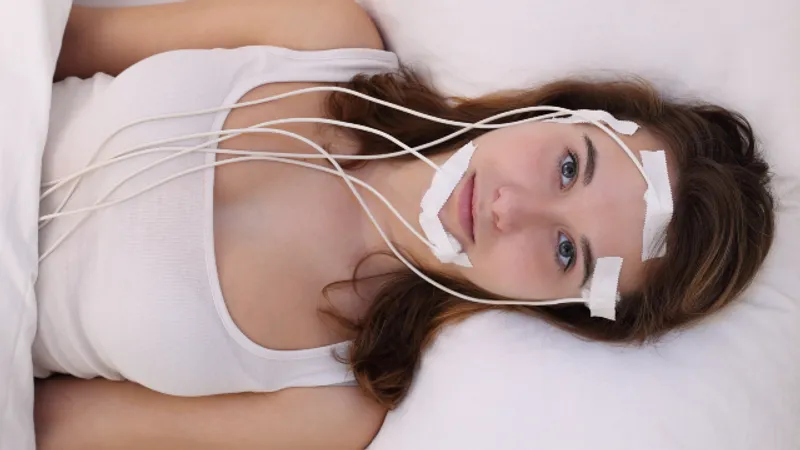
- Change into a gown and have sensors attached
- Overnight monitoring while brain activity, eye movements, muscle activity, breathing, heart rhythm, oxygen and other signals are recorded
- Wake in the morning, equipment removed, examination complete
Before testing, patients complete a sleep-symptom questionnaire and/or consult a physician. The clinic notes the examination is non-painful, with sensors attached while the patient sleeps, and that no anesthesia or invasive needles are required.
Preparation that actually changes the result
The published preparation is short and every item has a reason:
Avoid caffeine, alcohol and napping on the day of the test. All three alter the thing being measured.
Wash your hair and remove styling products before sensor application. Unglamorous and genuinely necessary — adhesion determines signal quality.
Complete the questionnaire or consultation beforehand.
Arrive prepared to sleep overnight rather than treating the visit as an appointment. The clinic makes this point explicitly, and it is the one visitors most often get wrong: this is a night away from your hotel, with a bag.
What it is like, honestly
The clinic does not oversell the experience, and neither will this article.
The published practical issues are temporary discomfort from attached sensors and difficulty sleeping normally in an unfamiliar environment. Risks are described as virtually nonexistent medically, with minor skin redness or irritation from sensor adhesives possible.
On the day after: the examination ends after waking and removing the equipment, patients can resume regular routines, and the clinic notes that patients may work the following day, although those who are particularly tired may prefer to arrange a day off.
For a traveler, that last sentence is a scheduling instruction. Do not put the sleep study on the night before a long flight, and do not put anything demanding on the day after.
The exclusions
Two named: patients with acute life-threatening or medically unstable conditions, and patients with severe skin allergies to electrode adhesives.
The second is easy to overlook and easy to disclose. If adhesive dressings have caused you problems before, say so in the pre-consultation rather than discovering it with a full set of sensors attached at eleven at night.
The scheduling arithmetic for a visitor
Put the published figures together and the shape of the trip appears.
One overnight visit for the study itself.
Several days before results are analyzed and discussed.
Possibly a second study. The clinic states that some patients may require additional consultation or a second study for pressure adjustment — which, if it applies, extends the trip substantially.
A follow-up consultation at which results are reviewed and a treatment plan initiated based on the findings.
So the minimum realistic shape is: consultation, one night, a gap of several days, then a results appointment. A trip built on the assumption that a sleep study is a single evening will not accommodate the second half of that.
The clinic recognizes the issue in its own words, noting that a key consideration is whether the patient can remain in Korea long enough for the overnight study and follow-up interpretation. That sentence is doing you a favor; use it as the basis for the question you send.
Send it through the clinic's enquiry page, which is where the pre-test questionnaire and physician consultation are arranged.
What a sleep study does and does not deliver
The published benefit statement is precise: the primary benefit is diagnostic clarification and treatment planning, rather than a guaranteed cure from the sleep study itself. Polysomnography can help identify sleep apnea, abnormal breathing, periodic limb movements, dream-enactment behavior and other sleep abnormalities.
That is the correct framing. A sleep study is a measurement. It tells you what is happening and it is the input to a treatment decision — it is not itself a treatment, and no night in a lab has ever improved anyone's sleep by being conducted.
Which means the value of the trip depends entirely on what happens with the result afterward, and that is a question about arrangements where you live as much as about the clinic.
The clinic's description of how it approaches care sets out the sequence the follow-up would fall within.
Why sleeping badly in the lab is not a wasted night
The most common worry about an in-lab study is the obvious one: how can a test of sleep be valid when the surroundings make sleep difficult?
The clinic names it as a practical issue rather than dismissing it — difficulty sleeping normally in an unfamiliar environment appears in its published list alongside sensor discomfort.
The reassuring part is structural. The study records brain activity, breathing, oxygen saturation, heart rate and movements continuously through whatever sleep does occur, and the abnormalities it looks for — pauses in breathing, drops in oxygen, periodic limb movements, dream-enactment behavior — appear within sleep rather than requiring a full unbroken night of it.
That does not make a bad night ideal. It does mean that the common fear of having wasted the trip by not sleeping well is usually misplaced, and it is a fair thing to raise with the clinic in advance rather than lying awake worrying about it in the room.
The four conditions the clinic names, and how they differ
The approved statement names insomnia, snoring with suspected sleep apnea, restless legs syndrome, and REM sleep behavior disorder. Those are four quite different problems and they are worth distinguishing, because which one the history suggests shapes whether an overnight study is the right test at all.
Snoring with suspected apnea is the presentation the clinic explicitly says may sometimes be handled by home testing instead. It is also the one most often reported by a partner rather than by the patient.
Insomnia — difficulty falling or staying asleep — is frequently assessed without an overnight study in the first instance, because the diagnostic question is often about pattern and history rather than about physiology.
Restless legs presents as nighttime leg discomfort with an urge to move, which the published candidate list names directly.
Dream enactment — physically acting out dreams — is the one where an overnight study is most clearly indicated, because the behavior has to be captured alongside the sleep stage it occurs in.
Describing which of the four best matches your experience is the most useful thing you can send ahead of a consultation.
The partner's account, which is half the history
For three of those four conditions, the person best placed to describe what happens is not the patient.
Snoring, pauses in breathing, gasping, leg movements and dream enactment are all observed from outside. A patient reporting only unrefreshing sleep and daytime tiredness is giving a clinician the consequence without the cause.
So if you share a bed, bring the account. Written down, specific, and covering: what the breathing sounds like, whether it stops, whether it resumes with a gasp, whether the legs move, and whether you ever appear to act out a dream.
If you sleep alone, a phone recording of a night's audio is an imperfect but genuine substitute, and it costs nothing.
The follow-up appointment is the one that matters
Easy to treat the study as the event and the results discussion as an administrative postscript. It is the other way round.
The published aftercare states that results are reviewed at a follow-up consultation with a treatment plan initiated based on the findings. The study produces data; the consultation turns it into a decision.
Which is why the scheduling arithmetic earlier in this article matters so much. A trip that accommodates the night but not the results appointment has bought the measurement and left the interpretation behind — and a report you cannot discuss is considerably less useful than one you can.
The Bottom Line
- One overnight visit, results within several days. Both figures are published, and the gap between them is the scheduling problem.
- The clinic names an alternative to its own service: for uncomplicated suspected obstructive sleep apnea, technically adequate home testing may be appropriate instead of an in-lab study. Ask which applies before traveling.
- What is recorded is published: brain activity, breathing, oxygen saturation, heart rate, movements and other sleep-related signals, non-invasively and without radiation.
- Preparation changes the measurement — no caffeine, alcohol or napping on the day, and wash out hair products before sensors go on.
- A second study may be needed for pressure adjustment, which would extend a trip considerably.
Frequently Asked Questions
How long does the sleep study take?
One overnight visit. The patient arrives in the evening and the examination is complete after waking the next morning.
How soon are results available?
The clinic states results take place within several days, with comprehensive findings and treatment recommendations typically discussed within a few days of the physician's analysis.
Do I definitely need an in-lab study?
Not necessarily. The clinic states that not every sleep complaint requires an overnight study, and that for uncomplicated suspected obstructive sleep apnea it is either polysomnography or technically adequate home testing in appropriate adults.
What is recorded during the night?
Brain activity, eye movements, muscle activity, breathing, heart rhythm, oxygen saturation, movements and other sleep-related signals.
Is it painful or does it involve radiation?
No. The clinic describes it as non-painful with sensors attached while the patient sleeps, requiring no anesthesia or invasive needles, and states that it does not expose the body to radiation.
How should I prepare?
Avoid caffeine, alcohol and napping on the day of the test, wash your hair to remove styling products before sensors are applied, complete the questionnaire or consultation beforehand, and come prepared to sleep overnight.
Can I work the next day?
The clinic notes that patients may work the following day, although those who are particularly tired may prefer to arrange a day off.
Might I need a second night?
The clinic states that some patients may require additional consultation or a second study for pressure adjustment. Ask how likely that is in your case before booking travel.
This article is for general informational purposes and does not constitute individualized medical advice. It is not a self-diagnosis tool. A sleep study is a measurement rather than a treatment, and whether one is appropriate for you — or whether home testing would be adequate — can only be determined by a qualified neurologist or sleep physician who has reviewed your symptoms and history.